
Nicki Minaj is arguably one of the most polarising contemporary female artists, despite being a self-proclaimed ‘bad bitch, no muzzel’1and an advocate of showcasing the strength of women.2 Her controversial second single ‘Anaconda’ was no exception and has been subject to much criticism. Whilst on the surface, the song appears explicitly sexual and damagingly objectifying, it is possible to say that Minaj’s work is an empowering anthem.
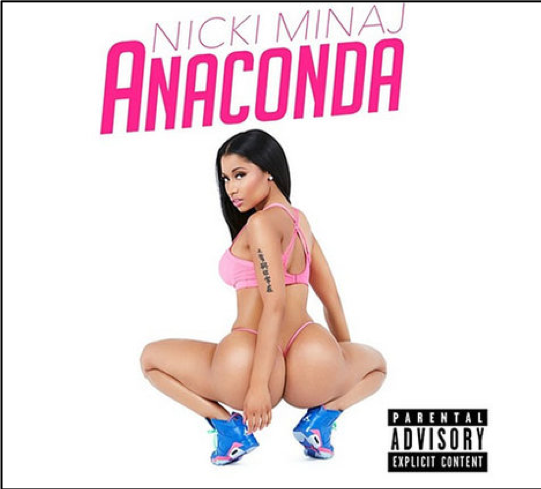
The conception of ‘Anaconda’ was a reactionary response to Sir Mix-A-Lot’s transparently sexist song – ‘Baby Got Back’ (1992) – which was unquestionably crafted by and for the male gaze, referencing the (black) female buttocks throughout. Minaj’s adaptation sought to reclaim control over female objectification through the heavy sampling of his work, adapting its sexual lyrics and racy music video. By modifying an objectifying song, which declares a desire for a certain female body type, Minaj is able to reclaim control over the female body.
Whilst he claimed his song celebrated curvy women, his message was lost in translation with an erotic video comprising half naked women twerking for the indulgence of fully clothed men. Even without the video, the lyrics clearly objectify women; the line ‘my anaconda don’t want none unless you got buns hun’, portrays a woman’s worth as entirely sexual and governed by a man. By sampling Sir Mix-A-Lot’s line, Minaj inverts the power dynamic, transforming it into a parody. In Minaj’s version, two repetitions of ‘My anaconda don’t’ precede Sir Mix-A-Lot’s line ‘My anaconda don’t want none unless you got buns hun’ to open the song. This disruption of his lyrics mid-sentence allows Minaj to reclaim his sexist term ‘Anaconda’ and in turn assert female power and subvert his derogatory meanings.
Minaj also subverts derogatory nuances within Sir Mix-A-Lot’s music video. His video opens on two white women expressing disgust at the figure of a black woman:
‘Oh my god, Becky, look at her butt … they only talk to her because she looks like a total prostitute … I mean, her butt is just so big … she’s just so black!’
– Sir Mix-A-Lot ‘Baby Got Back’
The woman in question adopts the central focus of the shot, suggestively running her hands over her figure-hugging canopy dress, all the while gyrating her posterior in a lascivious manner. With an intent to elicit sexual arousal, this image plays into the male gaze, encouraging men to lay their fantasies upon this anonymous woman who never receives facial identity. Minaj inverts the racial hierarchy, instead providing the black woman a voice who imitates the white women’s comments. Minaj converts these remarks into: ‘Oh my gosh, look at her butt’ substantially edited to emulate a mimicking tone of voice. For those familiar with ‘Baby Got Back’ such a humorous reworking reclaims the black female body as an object of appreciation not of condescension. A positive portrayal of the black female body is emphasised in the music video, where a posterior-focused dance accompanies these lyrics, drawing attention to the attribute criticised by the two white women and objectified by Sir Mix-A-Lot.
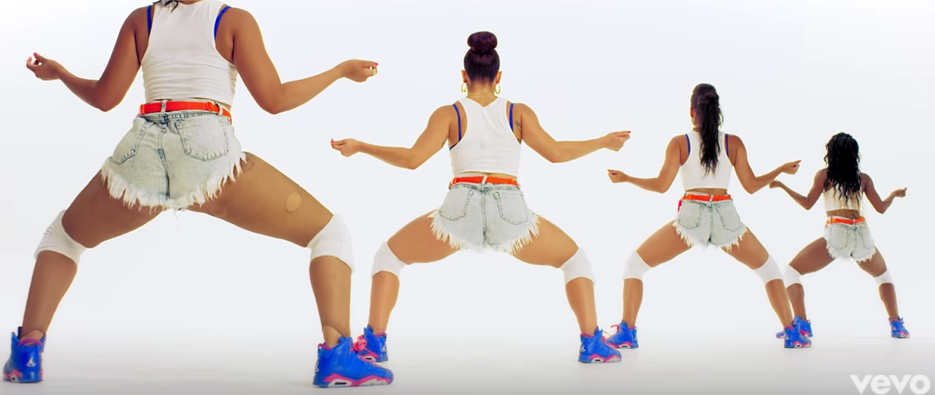
Aside from the sampling of Sir Mix-A-Lot, Minaj’s own lyrics provide empowering messages. Using two main verses, Minaj subverts the power dynamics of gender in conventional hip-hop/rap themes, establishing two males at her disposal: Troy and Michael. Unlike Sir Mix-A-Lot, these men are at least named, yet Minaj immediately demonstrates her power over them through possessive language. The first verse goes:
By the way, what he say?
He can tell I ain’t missing no meals Come through and fuck ‘em in my automobile Let him eat it with his grills,
He keep telling me to chillHe keep telling me it’s real, that he love my sex appeal
– Nicki Minaj
He said he don’t like ‘em boney, he want something he can grab So I pulled up in the Jag, and I hit ‘em with the jab like… Dun-d-d-dun-dun-d-d-dun-dun
Minaj takes control of the narrative, making curvaceous women agents, not objects. She owns her own ‘automobile’, she lets him ‘eat it with his grills’ (gold teeth), she ‘hit ‘em with the jab’ (displayed her cleavage). Contrasting with Sir Mix-A-Lot’s line ‘you say you wanna get in my benz’, Minaj reverses dominant gender roles by pulling up in her own ‘jag’. This first verse also demonstrates Minaj’s awareness of the power of her sex appeal, promoting a curvaceous body type that isn’t ‘boney’, and that ‘ain’t missing no meals’ but is ‘something he can grab’. Whilst these lyrics appear self- objectifying, Minaj is acknowledging the power of her body to manipulate the male libido. She then goes on to compare her body to ‘NyQuil’ (an antihistamine known to make one sleepy) further establishing the dominant effect the female body can have over the male.
Minaj also challenges the requirement that objectified women pander to the male gaze in her music video. Minaj chooses to be the subject of the male gaze only to then undermine the power structure and re-establish herself as the controlling figure of the narrative, not the object. Minaj engages humorously in several sexually-tinged activities, all of which are stereotypical ways women attract the male gaze. For example, she sprays whipped cream over her chest, wears an erotic French maid’s costume and engages in fellatio with a banana. The banana is then abruptly sliced in half comically illustrating her power over the male gaze and masculine dominance. Minaj uses these actions to subvert domesticity by setting these events in the kitchen, a room systemically portrayed as a woman’s place by misogynists. This carefully constructed engagement with misogynistic sexual norms mocks the male gaze and highlights the absurdity of such fantasies. Minaj makes comedy of the male desire, remaining entirely aware and in control of the situation.
Minaj’s video portrays an all-female universe where men cease to exist further establishing ultimate female empowerment. As a genre with a history rooted in misogyny, her choice to eradicate the male presence not only dismantles an established custom but enables Minaj to own her sexuality without any objectification that a male presence might ensue. Within rap music videos, McFarland (2003) found that 37% of rap songs depicted women as simply objects of male desire and pleasure.3 Whilst Minaj’s engagement in overtly sexual movements is comparable with such behaviour, she removes generic hierarchies and instead assumes the same position as surrounding female dancers, thus all women receive the same treatment. When the single male character in the video appears, he functions merely as a prop for Minaj with no narrative importance other than to receive a lap dance. As he remains on a chair with no control of the situation, Minaj is left entirely dominant. The vulnerability of man to a woman’s sex appeal is humorously highlighted as his hand begins to hover over Minaj’s body. His attempt to touch her is greeted with a slap before Minaj walks away. She is in command of the use of her body.
Minaj’s adaptation of a sexist song with derogatory connotations towards women enabled a reclamation of female control. The black female body is celebrated by Minaj and self-objectified to demonstrate the power it possesses over men, whilst simultaneously engaging with the Western standards of beauty, to which Minaj stands as the antithesis. Within her own lyrics, Minaj challenges the male dominance of the patriarchy and, as a successful female rapper, the pre-eminence of male rap artists. Inevitably, the nuance of such meanings are diminished if the listener/viewer is unfamiliar with Sir Mix-A-Lot’s work. Nevertheless, those who scratch beneath the surface will discover the empowerment anthem.
- As she stated in her 2012 track ‘Pound the Alarm’
- Frank, A. (2015). ‘Newly Single Nicki Minaj on Feminism, Meek Mill, and Rapping at 50’. In Vogue. Retrieved from: http://www.vogue.com/article/nicki-minaj-interview-feminism-pinkprint. Last accessed 23rd April 2016.
- McFarland, P. (2003). Challenging the contradictions of Chicanismo in Chicano rap music and male culture. Race, Gender & Class, 10 (4) 92-107.
 Hooked on Music